Overview
LLMs trained on web-scale corpora absorb dominant cultural values. When deployed across diverse populations, an interaction style that feels natural to one group may feel intrusive, or even threatening, to another. We put real users from underrepresented cultures in front of these systems and measured how they actually react.
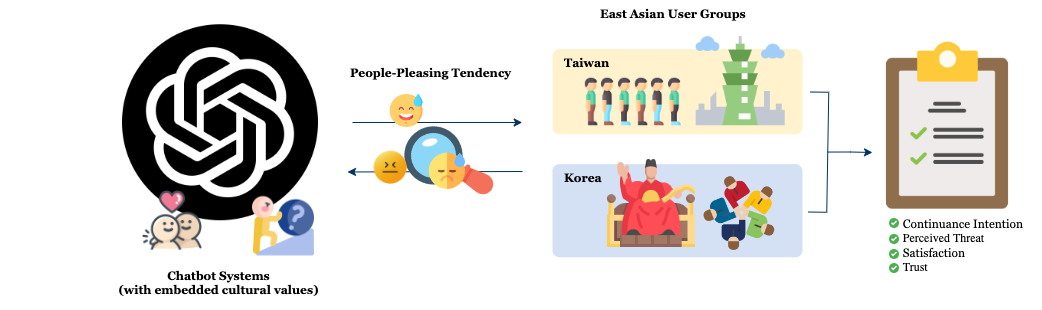
Most existing work examines model outputs. Far fewer studies put real users from underrepresented cultures in front of deployed LLMs and measure how culturally embedded interaction styles are actually received. We focus on Taiwanese and Korean users, whose cultures and languages are underrepresented in mainstream training data, and ask whether a personality trait, people-pleasing tendency, changes the picture.
Does people-pleasing tendency (PPT) moderate the effect of chatbot interaction style on users' intention to collaborate?
Does PPT moderate the relationship between chatbot style and users' collaboration experience (satisfaction, trust, threat)?
How do cross-cultural differences in style perception reflect different interactional expectations across cultural contexts?

Experimental Design
We operationalized supportive and challenging interaction styles through GPT-4.1 system prompts (temperature 0.2) along four dimensions, each mapping onto contrasting cultural interactional scripts. Both styles were then deployed in a controlled interaction task with real users from Taiwan and Korea.
Study Procedure
101 participants (Taiwan n=49, Korea n=52) from the MZ generation (born 1981–2007) completed a collaborative tourism-planning task in their native language, interacting with either the supportive or challenging chatbot.
Informed consent, Basic Information, People-Pleasing Scale
3-stage tourism-planning task,
(recall → itinerary → promo copy)
min. 8 turns per stage
Perceived Threat, Satisfaction, Trust, Continuance Intention, Open-ended questions
| Measure | Items | Scale | Source |
|---|---|---|---|
| People-Pleasing Scale (PPS) | 10 | 5-point Likert | Blötner (2025) |
| Perceived Threat (PT) | 6 | 7-point Likert | Yanan (2023) |
| Satisfaction (SA) | 3 | 5-point Likert | Chin et al. (1988) |
| Trust (TR) | 8 | 7-point Likert | Dolinek and Wintersberger (2022); Scharowski et al. (2024) |
| Continuance Intention (CI) | 3 | 7-point Likert | Bhattacherjee (2001) |
All instruments administered in the participant's native language (Taiwan Mandarin / Korean). All scales α > .70 in both samples.
Results
Supportive style increased CI, satisfaction, and trust in both samples.
CI: β = 2.48 (TW) · 2.17 (KR), p < .001The challenging style raised threat in Taiwan but NOT in Korea.
PT: β = −2.65 (TW, p<.001) · −0.73 (KR, n.s.)All Style × PPT interactions were n.s. However, PPT showed a Taiwan-only main effect on perceived threat (β = .08, p < .05), reflecting higher baseline sensitivity, not stronger responsiveness to style.
Style × PPT (all n.s.) · PT main effect TW onlyFull regression coefficients for all outcome variables across both samples.
| CI | SA | TR | PT | ||||||
|---|---|---|---|---|---|---|---|---|---|
| Predictor | Sample | β | p | β | p | β | p | β | p |
| Chatbot Style | TW | 2.48*** | <.001 | 1.83*** | <.001 | 1.88*** | <.001 | −2.65*** | <.001 |
| KR | 2.17*** | <.001 | 1.44*** | <.001 | 1.31*** | <.001 | −0.73 | n.s. | |
| People-Pleasing Tendency (PPT) | TW | 0.07 | n.s. | 0.03 | n.s. | 0.02 | n.s. | 0.08* | <.05 |
| KR | 0.02 | n.s. | 0.02 | n.s. | 0.04 | n.s. | 0.08 | n.s. | |
| Style × PPT | TW | −0.07 | n.s. | −0.03 | n.s. | −0.03 | n.s. | −0.05 | n.s. |
| KR | 0.02 | n.s. | 0.02 | n.s. | 0.02 | n.s. | −0.06 | n.s. | |
| R² | TW | 0.53 | 0.63 | 0.59 | 0.66 | ||||
| KR | 0.35 | 0.34 | 0.45 | 0.16 | |||||
Discussion
The same conversational style improved collaboration across cultures, but did not carry the same social meaning.
Supportive style consistently increased continuance intention, satisfaction, and trust in both samples, regardless of cultural background.
Supportive style benefits are robust across interpersonal orientations. PPT reflects users' baseline emotional sensitivity in human-AI interaction, not their responsiveness to specific chatbot styles.
Challenging style increased perceived threat in Taiwan but not Korea, even across two broadly collectivist settings. The same output activated divergent social scripts: harmony-sensitive in Taiwan, task-oriented in Korea.
Use supportive cues as a cautious default; audit directness; and adapt to linguistic signals, not static personality labels.
Limitations
These results suggest a cultural pattern, not a validated cultural mechanism.
Off-task requests sometimes shifted the intended chatbot style.
English-dominant training may introduce Western defaults into Mandarin and Korean outputs.
Quantitative patterns and open-ended clues do not directly validate participants' cultural interpretations.
Two East Asian samples and a tourism task limit generalization to other cultures and high-stakes domains.